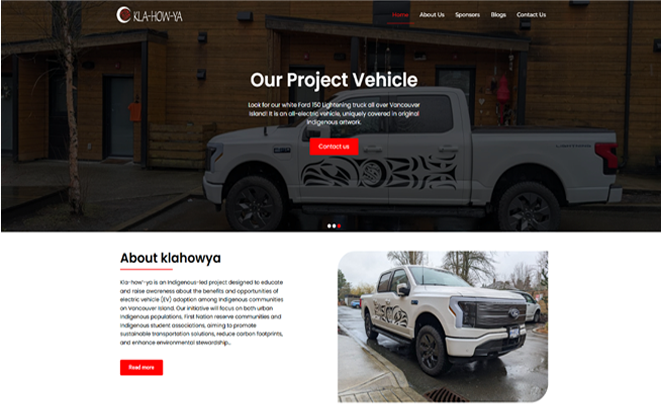
Kla-how’-ya is an Indigenous-led project designed to educate and raise awareness about the benefits and opportunities of electric vehicle (EV) adoption among Indigenous communities on Vancouver Island. Our initiative will focus on both urban Indigenous populations, First Nation reserve communities and Indigenous student associations, aiming to promote sustainable transportation solutions, reduce carbon footprints, and enhance environmental stewardship.
Kla-how’-ya is a Chinook word that translates to English as a salutation, or an acknowledgement of another’s arrival or departure. It can mean hello, how are you and/or goodbye. We believe this is a reflection of the project, an exchange of ideas and information, a meeting or conversation between community members, with the intent of raising awareness of electric vehicles to the Indigenous community.
We chose the Chinook language because it was developed as a trading language between non Indigenous and the various Indigenous language groups throughout western Canada and the Pacific northwest.
NISA is proud to partner with Tsawalk Community Society, an Indigenous-led non-profit organization focused on cultural revitalization, community development, and Indigenous food systems. Current collaboration includes a seaweed and kelp project focused on youth training, processing skills, and the exploration of Indigenous-led marine economies. This work reflects a growing opportunity to reconnect communities with coastal food systems while building pathways for future economic participation.
NISA supports Indigenous procurement objectives by helping organizations identify, source, and deliver specialized products, equipment, technologies, and services through a network of qualified partners and suppliers. We are interested in opportunities that create Indigenous economic participation while meeting the operational needs of government, Indigenous organizations, educational institutions, and industry.
For example:
NISA is expanding its work into the Early Childhood Education (ECE) sector, with a focus on strengthening Indigenous workforce pathways, improving labour market understanding, and supporting more coordinated access to training and professional development. This includes early-stage work exploring shared digital infrastructure to better connect educators, organizations, and communities. To support this direction, NISA has established an Advisory Committee to provide guidance and ensure that this work remains grounded in community priorities and Indigenous ways of knowing and learning.